Brambles

Our 2030 sustainability vision is to create regenerative supply networks

We will do this by delivering tangible value for nature and communities, transforming supply networks, and ultimately driving a future of sustained prosperity for Brambles.

Brambles 2030 Sustainability Targets 2026 Sustainability Targets Progress

The definitions of key terms in bold are available in the Brambles 2030 Sustainability Targets document.

Further information, including the methodology behind the calculation of the metrics, is available in the Basis of Preparation – ESG Metrics 2026.

The definitions, boundaries and relevant metrics of our 2030 sustainability targets may continue to be refined across the 2030 Sustainability Programme. As these evolve, the relevant documents will be updated accordingly.

Brambles aims to achieve all targets noted in this document by 30 June 2030, unless stated otherwise.

Nature Positive

Brambles’ Nature Positive focus area aspires to build a regenerative nature-positive business by restoring and conserving ecosystems, going beyond zero waste and aiming to draw down more carbon than Brambles produces.

Learn more about our Nature Positive Programme:

Nature Positive Programme
Goal

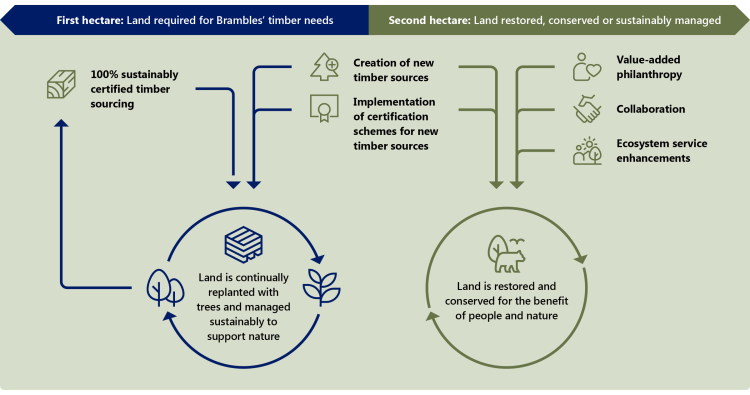
Regenerate two hectares for every one required for Brambles’ timber needs

Brambles’ 2030 programme places nature at its core, aiming to achieve nature-positive outcomes that support our regenerative vision.

Aligning with evolving nature-based metrics, we are transitioning from measuring our impact through the number of trees sustainably grown to look at ecosystems more holistically. To this end, we are moving to the restoration, conservation or sustainable management of two hectares for every one required for Brambles’ timber needs.

This change not only supports the Global Biodiversity Framework targets adopted at COP15, but also reflects a broader understanding of two key principles:

  • That trees generate their greatest value as part of functioning ecosystems, supporting biodiversity, regulating climate, and delivering benefits to people; and

  • That a diverse range of landscapes and ecosystems underpin the resilience of our operations and the forests we depend on, providing essential ecosystem services to our supply chain and
long-term sustainability.

Supporting UN Sustainable Development Goals

  • Enable the restoration, conservation or sustainable management of two hectares for every one required for Brambles’ timber needs cumulatively across the five-year period to 2030

  • Maintain 100% sustainably certified timber sourcing

  • Achieve year‑on‑year growth in the proportion of Chain‑of‑Custody certified timber purchases from 2025

  • Implement or contribute to one biodiversity initiative in five timber sourcing regions

  • Contribute to positive outcomes for people and communities through forestry and nature‑based initiatives in each of Brambles’ five operating regions

  • Issue annual nature‑related disclosures and adopt relevant nature‑related targets, metrics, measurement methodologies and reporting practices

Our target

Enable the restoration, conservation or sustainable management of two hectares for every one required for Brambles’ timber needs cumulatively across the five-year period to 2030

Our 2030 land regeneration target
  • Restoration is the process of assisting the recovery of an ecosystem that has been degraded, damaged or destroyed.

  • Conservation is the process of protecting and managing land in ways that maintain or enhance the ecological integrity of ecosystems, safeguard natural habitats and support the long term viability of populations of species in their natural surroundings.

  • Sustainable management refers to land managed in compliance with Brambles’ Global Timber Sourcing Policy, including in accordance with one of the two most globally-recognised standards, both of which include requirements to prevent deforestation and forest conversion.

Goal

Achieve Brambles’ science‑based targets and respond to climate change impacts through adaptation and mitigation measures

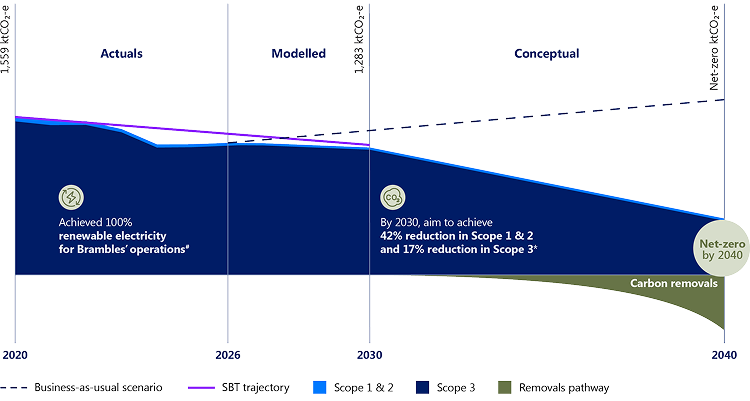
Brambles is continuing in the pursuit of our validated 2030 science-based targets and 2040 net-zero ambition, while at the same time formalising our efforts to enhance climate resilience through a new 2030 target that focusses on integrating climate adaptation processes across Brambles’ timber sourcing and service centre network.

Further, Brambles’ climate adaptation plan will enable our teams to support customers and communities better during disruptions by leveraging our resilience. In our materials sourcing supply chain, this means securing certified raw materials while understanding climate risks related to forestry.

Supporting UN Sustainable Development Goals

  • Achieve validated 2030 science‑based emission reduction targets to progress towards our ambition of net-zero GHG emissions by 2040

  • Integrate climate adaptation processes across Brambles’ timber sourcing and service centre network to enhance resilience against physical climate-related risks

  • Maintain 100% renewable electricity in Brambles’ operations

  • Maintain 100% screening of Brambles operated and subcontracted locations for vulnerability to severe weather events

  • Maintain at least 90% training completion on Brambles' Climate Risk Screening Tool for timber procurement professionals

  • ^SBTs to 2030 cover Scope 1 emissions (net of biogenic emissions and contractual instruments), Scope 2 emissions (calculated using a market-based approach) and certain Scope 3 emissions. The Scope 3 emissions categories within the scope of Brambles’ target are Category 2: Capital goods (related to product materials), Category 4: Upstream transportation & distribution, Category 5: Waste generated in operations, Category 9: Downstream transport & distribution and Category 10: Processing of sold products (related subcontracted service centres).

  • #Brambles uses Energy Attribute Certificates (EACs) to achieve its renewable electricity target, and Renewable Gas Guarantee of Origin (RGGO) Certificates in relation to Scope 1. In addition, it plans to use carbon removals to achieve its net-zero ambition. Carbon removals refers to the process of actively extracting carbon dioxide (CO2) from the atmosphere and storing it permanently.

  • *Brambles’ operations refers to locations under Brambles’ operating control (relating to Scope 1 & 2) and excludes third party managed locations.


Learn more about our net-zero roadmap
Goal

Reach 80% net-positive solutions for Brambles’ product waste, and for virgin plastic substitution in Brambles’ products

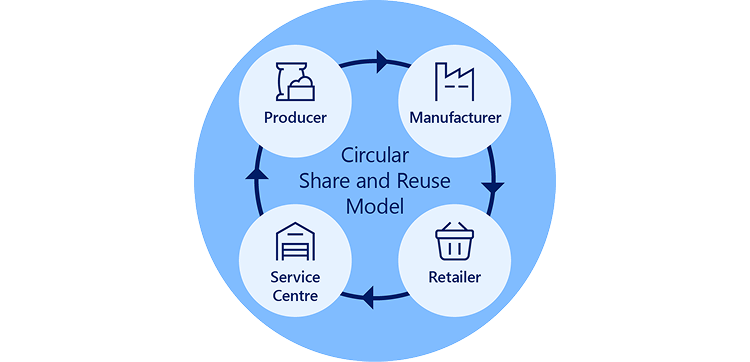
Brambles is embedding circular economy principles throughout our product lifecycle, conducting life cycle assessments (LCAs) during product development, incorporating digital readiness, waste reduction and planning for closed-loop outcomes at the end of a product’s lifecycle.

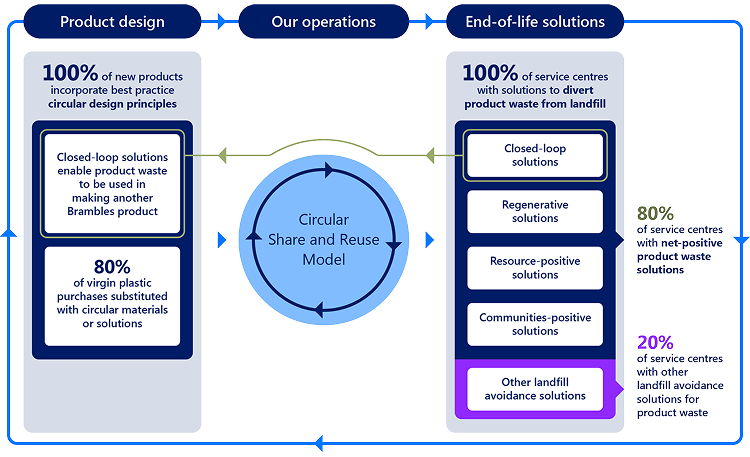
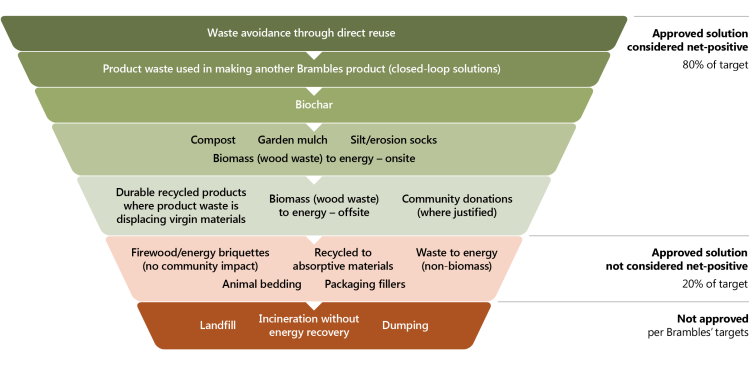
Our target to implement solutions to divert all product waste from landfill will be further strengthened by prioritising those landfill avoidance solutions that are closed-loop, regenerative, resource-positive or communities-positive. At the same time, ambitions around recycled plastic content are increasing to substitute 80% of virgin plastics with circular solutions.

In recognition of the growing awareness and need for action on water, we are pleased to announce that under our 2030 targets, we will be focussing on water efficiency initiatives, with a priority on Brambles’ service centres in water-stressed areas.

Supporting UN Sustainable Development Goals

  • Implement solutions to divert all product waste from landfill for Brambles operated and subcontracted service centres

  • Implement net-positive product waste solutions across 80% of Brambles operated and subcontracted service centres

  • Substitute 80% of virgin plastic purchases with circular materials or solutions

  • Implement water efficiency initiatives at Brambles operated service centres in water-stressed areas

  • Implement circular design principles for all new products, including using sustainable materials to amplify durability and circularity 

Business Positive

Brambles’ Business Positive focus area supports circularity by increasing the environmental benefits in our customers’ supply chains, building a safe, inclusive and respectful workplace, and partnering for positive outcomes across the supply network and beyond.

Goal

Achieve year-on-year growth in circular benefits in Brambles’ customer supply chains

Our Supply Chain Positive target area is about creating value for customers and the environment by embedding circularity into supply chains. Brambles will focus on demonstrating the positive impact on customers’ supply chains by making them more circular through improved asset productivity and extended product lifecycles.

In addition, by incorporating circularity tools in customer engagements, we aim to influence customer behaviour, improving the circularity of our assets.

Brambles will continue to use LCAs to measure and report on the avoided environmental impact through the use of our circular products.

Supporting UN Sustainable Development Goals

  • Achieve year‑on‑year growth from 2026 in circular benefits in Brambles’ customer supply chains by converting from linear alternatives and improving asset productivity

Goal

Activate sustainability collaborations with 1,000 partners across Brambles’ supply network

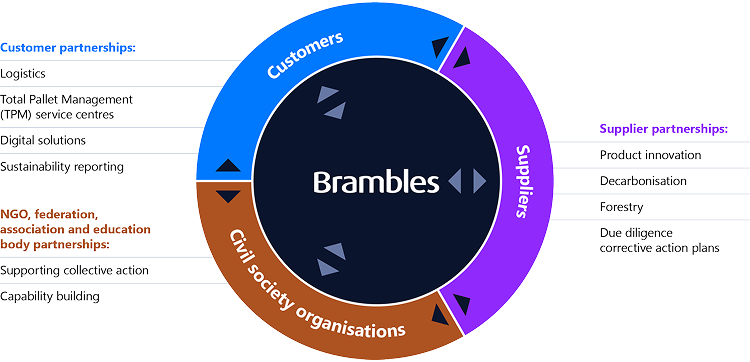
Our Positive Partnerships target area builds on the success of our 2025 Customer Collaboration programme, expanding it to a broader network of strategic partners including suppliers, NGOs, policymakers and educational institutions. Continuing on from our 2025 baseline, we aim to activate sustainability collaborations with 1,000 partners across our supply network.

Brambles acknowledges that no single organisation can solve complex sustainability challenges alone, making such partnerships an important aspect of achieving our sustainability ambitions. Strategic partnerships allow Brambles and our stakeholders to pool expertise, scale impact and unlock innovation across the supply chain.

In achieving this target, Brambles’ employees play a vital role in identifying opportunities, building relationships and driving conversations that lead to meaningful collaboration.

Supporting UN Sustainable Development Goals

  • Activate sustainability collaborations with 1,000 partners across Brambles’ supply network cumulatively across the five-year period to 2030

Goal

Continue the pursuit of Zero Harm and achieve a year‑on‑year increase in Brambles’ Employee Experience Index

Health, safety and wellbeing

Under the 2030 Sustainability Programme, Brambles will transition from using Brambles Injury Frequency Rate (BIFR) as the primary measure of safety culture and site conditions. Beginning in FY26, we will adopt Lost Time Injury Frequency Rate (LTIFR) as the key metric for reporting safety performance, while also monitoring Total Injury Frequency Rate (TIFR) internally.

This approach will enable Brambles to benchmark our performance against industry peers and strengthen our approach to risk management and injury prevention strategies.

The Brambles Safety First leading indicators will continue to support proactive safety measures across key areas and will remain an integral part of our performance monitoring.

Achieving true safety excellence means addressing all workplace injuries. By focusing on LTIFR and TIFR, Brambles reinforces its commitment to a safer, healthier work environment and the pursuit of Zero Harm.

Supporting UN Sustainable Development Goals


Diversity, equity and inclusion

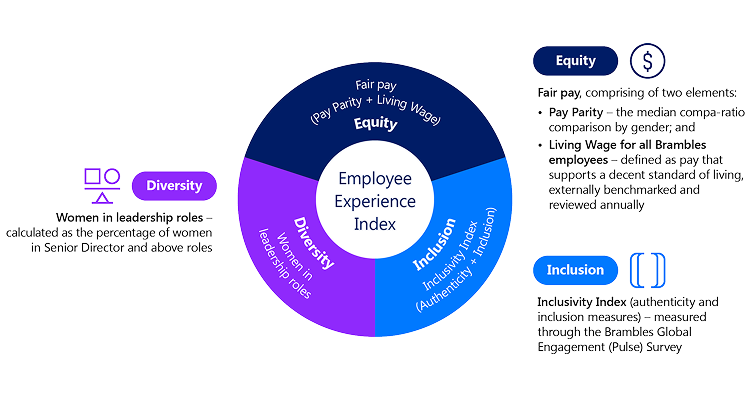
Brambles remains focused on achieving our gender representation goals, including 40% women on the Board and in management, and 12% women in service centres. Embedding DEI as the core of our new Employee Experience (EX) framework reflects our commitment to a workplace where everyone feels included, valued, treated fairly and transparently, and empowered to contribute to our innovative culture.

Under the 2030 Sustainability Programme, the new EX Index will focus on the three core pillars of DEI:

  • Diversity: Increasing the representation of women

  • Equity: Ensuring fair pay for our employees through ongoing pay equity assessments and alignment with living wage benchmarks; and

  • Inclusion: Strengthening our inclusive culture through employee feedback on authenticity and inclusion.

Leaders will be offered development support to voluntarily take more ownership of fostering inclusion, integrating DEI into decision-making and ensuring equitable access to opportunities.

This integrated approach is designed to strengthen and resonate with our global workforce and deliver long-term value to our people and stakeholders.

Supporting UN Sustainable Development Goals

  • Achieve a year‑on‑year increase in Brambles’ Employee Experience Index from 2026

  • Maintain the representation of women on the Board at 40% and increase the representation of women in management roles to 40% and in service centre roles to 12%

  • Reduce Brambles’ Lost Time Injury Frequency Rate from 1.0 to 0.9 by 2026 and 0.5 by 2030

Communities Positive

Brambles’ Communities Positive focus area promotes circularity, supports resilience, and reflects the connections between society, the economy and nature.

Goal

Promote regeneration, circularity and sustainability in policy development

As a global sustainability leader, Brambles aims to drive positive policy impact by engaging and advocating on issues central to our business. This includes accelerating the adoption of policies and programmes that advance the circular economy and promote responsible business practices.

To support this ambition, Brambles is establishing a dedicated Public Affairs function and policy engagement framework by 2026. Through direct consultation and involvement in industry groups, we will champion shared goals across key areas such as circular business models, climate action, nature conservation and DEI.

Our policy positions will be aligned with Brambles’ broader sustainability programme and targets. Leveraging our leadership in the circular economy, we aim to help shape policies that foster sustainable practices while reinforcing our long-term business growth strategy.

Supporting UN Sustainable Development Goals

  • Implement a global public affairs strategy, including programmes in each of Brambles’ five operating regions, to promote responsible business practices, advancing a regenerative circular economy

  • Implement a global Public Affairs function and develop a policy engagement framework by 2026

Goal

Achieve year‑on‑year increases in food waste avoided and food surplus rescued

Under our 2030 Sustainability Programme, Brambles will continue to support food banks, connecting food with rescue partners to help serve communities in need. While we have historically measured our impact through food surplus redistribution alone, we are expanding our approach to reflect the wider positive impact Brambles can have on the root cause: food waste is not a problem of supply, but of supply chain inefficiencies.

Sitting at the heart of these supply networks, Brambles is uniquely positioned to help reduce food loss from farm to retailer. By utilising our transport packaging innovations, network, experience and digital capabilities, we can keep food from spoiling and going to waste during its transportation, supporting our customers’ bottom line.

Beyond supplying food rescue networks with our assets, and through our employee volunteering programme, Brambles can support the creation of a more efficient and resilient food rescue and distribution network by contributing our supply chain expertise.

Supporting UN Sustainable Development Goals

  • Achieve year‑on‑year increases in food waste avoided and food surplus rescued using Brambles’ platforms, digital capabilities and collaborations with food rescue organisations from 2026

  • Drive efficiency and resilience in food rescue networks, leveraging Brambles’ expertise through targeted collaboration initiatives in each of Brambles’ five operating regions

  • Food donations sent: Surplus food is donated to food rescue organisations on CHEP platforms by growers, manufacturers and retailers.

  • Brambles’ assets: As food banks have CHEP customer accounts, the assets are dehired from donors, waiving some or all associated fees.

  • Food donations received: Food banks receive and sort the donated food into orders, sharing them with their charity partners on CHEP assets for distribution.

  • In-person volunteering: We offer three days* of paid volunteer leave per year to our permanent employees, with many using their time at local food banks.

    * Equating to approximately 24 hours per employee.

  • Skills-based volunteering: We leverage the skills and specialisations of our people to address specific needs and challenges faced by food banks.

  • Donations: We support food banks with financial donations, including our matching programme where donations made by employees to eligible charitable organisations are matched by Brambles.

  • Impact measured: We work with food banks to measure the quantity of food redistributed to their charity partners and track the number of meals served.

  • Returning Brambles’ assets: Food banks and their charity partners are responsible for CHEP’s assets in their accounts.

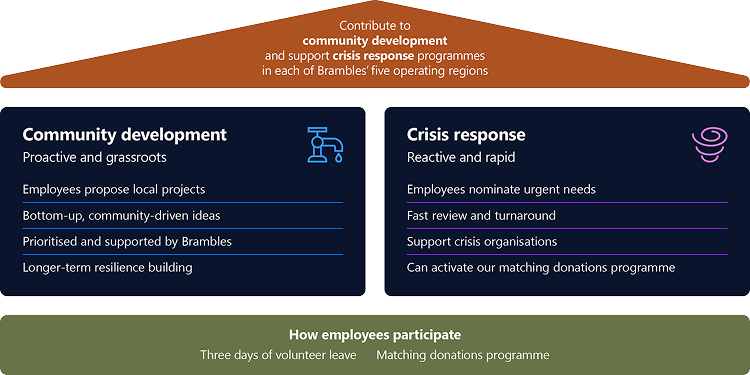
  • Going further: Brambles also tailors our support to specific regional needs and has developed a framework to support community development and crisis response in each of our five operating regions.

Goal

Leverage Brambles’ resources for community development and crisis response programmes

Brambles understands that the communities we operate in and rely on are facing increasing disruptions including from conflicts, natural disaster and climate‑related events. Customers such as food and grocery retailers and manufacturers play a vital role in emergency relief. Recognising this, Brambles aims to expand its in‑kind support beyond food banks, to facilitate the provision of donated essentials, including personal care items, through coordination with official emergency agencies.

We are committed to addressing regional challenges at the grassroots level, ensuring daily access to essentials and aligning with the interests of customers, suppliers and employees. By understanding local needs, Brambles will pursue strategic partnerships with governments, NGOs and customers to support crisis preparedness and recovery.

Through targeted projects, we will use our global network and expertise to deliver long-term community benefits in areas such as education, sanitation, nutrition and job skills training.

Supporting UN Sustainable Development Goals
  • Proactively contribute to community development and support crisis response programmes in each of Brambles’ five operating regions

  • Develop a framework for a community resilience programme to support ongoing community needs in each of Brambles’ five operating regions by 2026

  • Develop a framework for engaging with relevant authorities to support their crisis response programmes in each of Brambles’ five operating regions by 2026