

Strengthening forest resilience and ecosystem value
Brambles’ 2030 Forest Positive target area aims to regenerate two hectares for every one required for Brambles’ timber needs. By integrating regeneration into our supply chain and replenishing the resources we need, Brambles supports nature positive outcomes and long-term resilience.
Brambles’ Forest Positive target area builds on our long-standing commitment to 100% sustainably certified timber sourcing and strengthened through Chain-of-Custody (CoC) certified timber to ensure integrity and traceability across our global operations.
As expectations and maturity around nature continue to evolve, our approach has expanded beyond a focus on growing trees to consider forests as part of wider, interconnected ecosystems. This change acknowledges that the long-term value and resilience of forests depend not just on the timber they produce, but also on their contributions to biodiversity, climate regulation, and their connections to the landscapes and communities that our supply chains depend on.
In this context, our 2030 Sustainability Programme uses the land area required by our productive timber needs to drive improvements in the ecological systems that sustain it. This approach reinforces the health, resilience and biodiversity of those systems over time.
This integrated model positions Brambles’ Forest Positive programme as a driver of regenerative outcomes, strengthening the inherent connections between nature, communities, forest productivity and the long-term sustainability of Brambles’ operations.
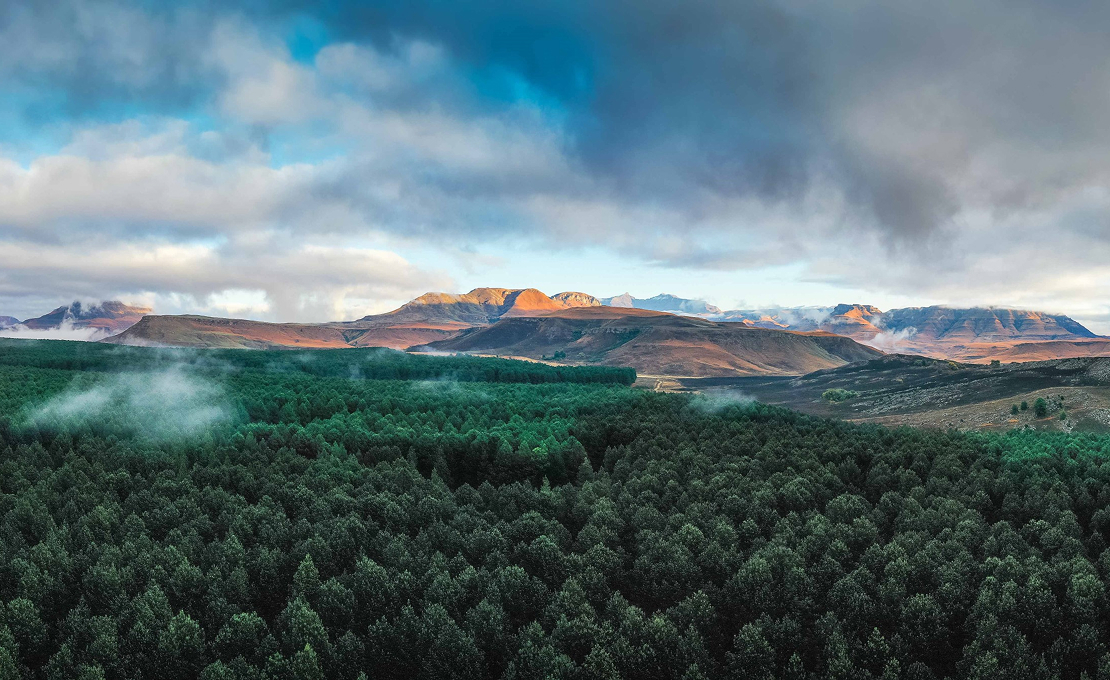
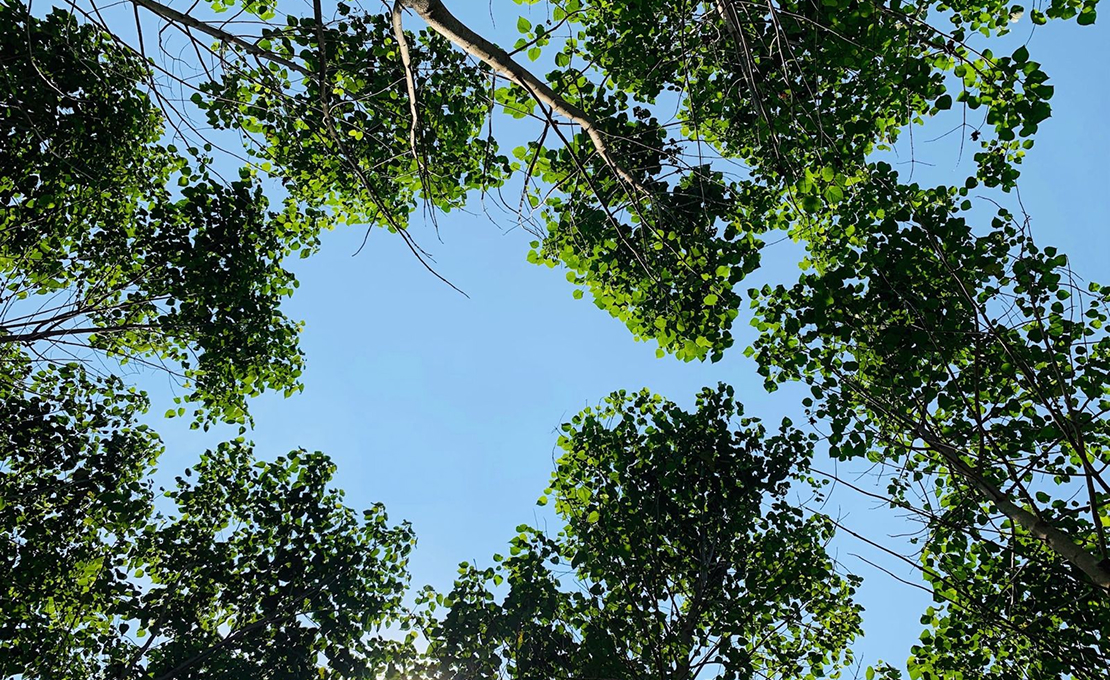
One of Brambles’ timber farms in South Africa. © Matthieu Rivart

Brambles’ sustainable sourcing
We are proud to report that we remain in full compliance with our global timber sourcing policy, with 100% of timber sourced from certified sustainable sources, supporting deforestation-free practices.
In FY26, we increased purchases carrying full CoC certification by 1.4-percentage points to 87.1%, strengthening supply chain traceability and support for human rights across the value chain. We will continue to grow CoC volumes while working with suppliers and certification bodies to better reflect new and emerging climate, biodiversity and human rights risks in certification standards.

Beyond sustainable sourcing
Brambles’ Forest Positive approach strengthens the resilience of the forests we depend on by supporting the health of surrounding ecosystems.
Recognising that productive forests rely on biodiversity, thriving water systems and local communities, our programme contributes not only to sustainable timber supply but also to broader ecosystem outcomes across our sourcing regions.
FY26 sustainable timber sourcing
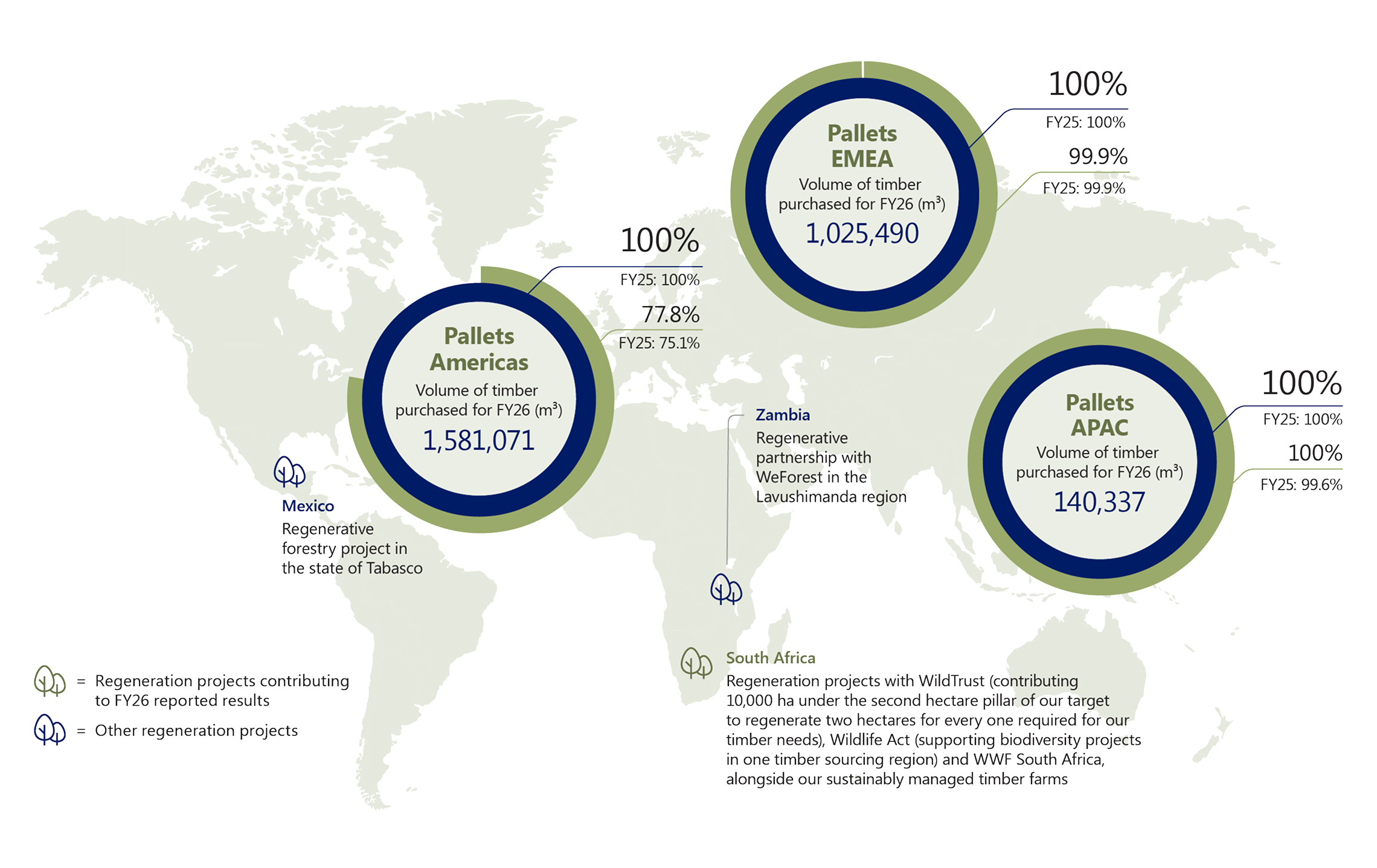
This infographic shows Brambles’ global timber procurement activity, demonstrating 100% sustainably certified timber sourcing.1 for FY26 and the regenerative projects contributing to our Forest Positive targets.
An equivalent of 22,471 hectares was needed to grow the timber for Brambles FY26 operations. This represents the basis for our target to regenerate two hectares for every one required. As this land is sustainably managed, it is also counted against the first hectare of this target, described further below.

1
Although 100% of Brambles FY26 timber purchases carried sustainability certification, a minimal volume of non-compliant timber was purchased. More information can be found on pages 36–37 of Brambles’ 2026 Annual Report.
Sustainably certified timber sourcing
Includes timber sourced either from certified forests or through a certified due diligence system under one of the two most recognised international forestry management schemes, or equivalent endorsed systems.
CoC certified timber purchases
CoC certification is available under one of the two most recognised international forestry management scheme. This certification requires that sustainably sourced timber is correctly tracked along the supply chain and that human rights are respected.
More information on sustainable forestry certifications is available here.
Our 2030 land regeneration target
The land required to meet Brambles’ timber needs is estimated from the volume of timber purchased. This defines the baseline number of hectares for the target. Where this timber is sourced through sustainably certified timber processes (as required under Brambles’ Global Timber Sourcing Policy), the associated land contributes to the first hectare.
The second hectare is enabled through strategic partnership projects that focus on restoration, conservation or sustainable management actions, producing regenerative outcomes for people and nature.
In some cases, land already recognised under the first hectare may also be recognised under the second hectare. This may occur where distinct additional outcomes are enabled beyond those already captured through the certification process for the first hectare, including improvements to plantation biodiversity and plantation forestry practices. In such cases, any such dual recognitions will be clearly disclosed.
Ensuring integrity and credibility
Our approach is underpinned by a structured methodology and robust governance framework:
- Clear rules for recognising hectares, including requirements for additionality and attribution;
- Documented evidence and commitments to support delivery;
- Transparent accounting, including how overlap between first and second hectare is treated;
- Dedicated Monitoring, Reporting and Validation (MRV) framework to track outcomes and support continuous improvement; and
- Annual review and reporting aligned with our sustainability governance processes.
First hectare
22,471 hectares
of land required to meet our FY26 timber needs, under sustainable management.

Second hectare
10,000 hectares
of additional land regeneration enabled in FY26.

Total land under regeneration
32,471 hectares
of land under restoration, conservation or sustainable management in FY26.
See below for more details on how the first and second hectare are calculated.
Our target
Enable the restoration, conservation or sustainable management of two hectares for every one required for Brambles’ timber needs cumulatively across the five‑year period to 2030

Restoration is the process of assisting the recovery of an ecosystem that has been degraded, damaged or destroyed.
Conservation is the process of protecting and managing land in ways that maintain or enhance the ecological integrity of ecosystems, safeguard natural habitats, and support the long term viability of populations of species in their natural surroundings.
Sustainable management refers to land managed in compliance with Brambles’ Global Timber Sourcing Policy including in accordance with one of the two most globally-recognised standards, both of which include requirements to prevent deforestation and forest conversion.
Nature Positive in action
Featured projects illustrating our efforts under our Nature Positive Programme